Jewellers usually sell eternity rings in two versions, full and half, and the two often sit side by side in the same display case at noticeably different prices. The gap reflects more than the number of stones, because the choice also decides whether the ring can be resized later and how it feels next to an engagement ring.
What an Eternity Ring Actually Is
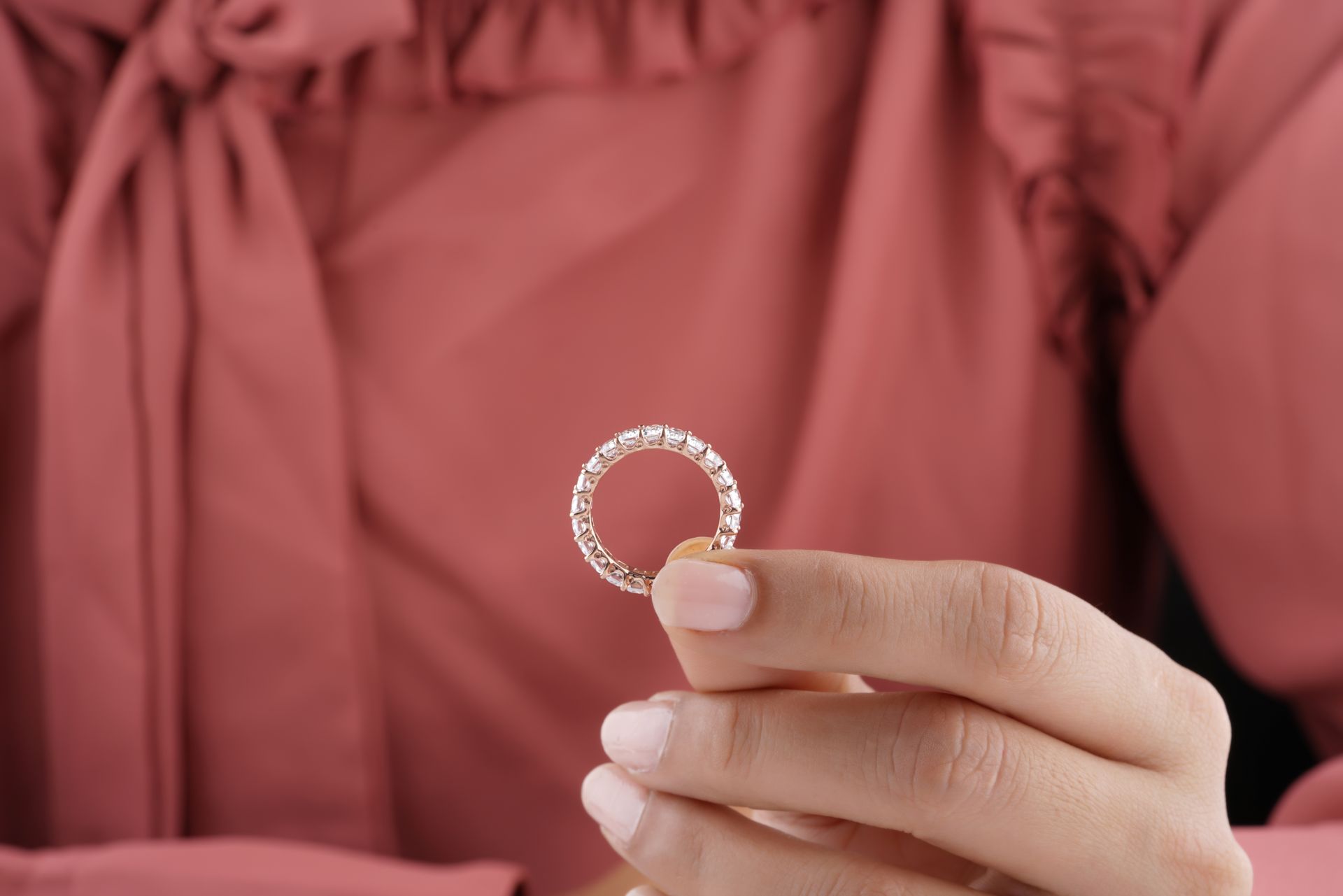
An eternity ring is a band set with a continuous row of matching stones, almost always the same size and shape, running along the band instead of gathering around one centre stone. The unbroken line of stones is meant to represent love without an end, which is where the name comes from.
That row of matching stones is what separates it from the rings it’s usually worn with. An engagement ring is built around a single centre stone or a feature cluster, and a traditional wedding band is plain metal or carries only a few small diamonds. An eternity ring has no centre stone at all, and some couples skip a plain wedding band and use an eternity ring in its place.
How the stones are held changes the look more than beginners expect. Claw settings grip each stone with small metal prongs, so more light enters from the sides and the ring looks brighter, but the claws can catch on knitwear. Channel settings slot the stones between two walls of metal, which gives a smooth edge that won’t snag and protects the stones, at the cost of a little sparkle. Grain and micro-pavé settings hold very small stones with tiny beads of metal, producing a fine, glittering surface that suits narrow bands.
Eternity rings are traditionally given to mark an anniversary, the birth of a child or a vow renewal.
Diamonds are the most common choice, but sapphire, ruby and emerald versions are widely available, as are designs that alternate coloured stones with diamonds.
What Makes a Ring a Full Eternity Ring
On a full eternity ring the stones run all the way around the band, with no plain metal anywhere.
That continuous circle is also why a full eternity ring usually can’t be resized. Stretching or cutting the band would disturb the settings on every side, so in most cases the only fixes are remaking the ring or, on some designs, adding or removing a stone, which costs far more than an ordinary resize. The size has to be right at the point of purchase, ideally measured at a normal temperature and time of day, since fingers swell in heat and shrink in the cold.
Because there is no plain section, the ring looks the same however it turns on the finger. The stones on the palm side are the ones people tend to notice once they start wearing it, since they press against the fingers on either side when the hand closes and take knocks from a desk edge, a steering wheel or a gym bar.
Covering the whole band roughly doubles the number of stones compared with a half eternity ring of the same design, so both the total carat weight and the price climb accordingly.
What Makes a Ring a Half Eternity Ring
A half eternity ring sets stones only across the top of the band, the part that faces up when the hand is flat. Despite the name, coverage varies: some designs set stones across about a third of the band, and three-quarter versions extend further round while still leaving a plain section underneath.
That plain section is what makes a half eternity ring practical. A jeweller can usually cut or stretch it to change the size by one or two sizes without touching the stones, and the smooth metal under the finger is more comfortable when gripping things or wearing the ring next to another band.
With roughly half the stones of a full version, a half eternity ring costs noticeably less for the same stone size, or allows larger stones for the same budget.
The trade-off is rotation. If the ring is slightly loose, it can spin round the finger and leave the plain underside showing on top, and a ring that is too tight to spin will be uncomfortable when fingers swell in warm weather. A snug fit that still slides over the knuckle keeps the stones where they should be.
Full vs Half Eternity Ring: Which Differences Matter Day to Day
Stacking is where the full vs half eternity ring decision shows up first. Worn next to an engagement ring and a wedding band, a full eternity ring adds a band of stones between the fingers on the palm side, which can feel bulky and rub against the neighbouring rings. A half eternity ring has plain metal in that position, so the stack sits more comfortably.
Fingers rarely stay the same size for decades. Pregnancy commonly causes swelling that can last months, and knuckles often thicken with age. A half eternity ring can usually be adjusted to follow those changes, while a full eternity ring that no longer fits may have to sit in a drawer or be remade.
On cost, the same design and stone size in full eternity uses roughly twice as many stones, so it lands at a significantly higher price even before the extra setting work is counted.
Daily wear also falls more heavily on full eternity rings. The stones underneath take the pressure of every grip and knock, so their settings wear faster and need checking more often, especially for anyone who works with their hands or lifts weights.
As a rule of thumb, choose a half eternity ring if comfort, stacking and the option to resize matter most, and a full eternity ring of unbroken sparkle from every angle is the priority and the wearer’s ring size is stable. Seeing full and half eternity rings side by side on the hand usually settles the decision faster than any photo.